
S Mahendra Dev, chairman of the Economic Advisory Council to the Prime Minister, expressed confidence that the rupee would stabilise around the 92-93 level against the US dollar, despite geopolitical tensions, and that foreign investment flows would return.

China's post COVID-19 pandemic economic rebound showed signs of slowdown as the economy grew at 7.9 per cent in the second quarter compared to a record 18.3 per cent in Q1, while the GDP expanded 12.7 per cent year on year in the first half amid the continued global spread of the coronavirus and unbalanced domestic recovery. In the second quarter, the GDP of the second largest economy in the world grew 7.9 per cent year on year, the data released by the National Bureau of Statistics, (NBS) on Thursday showed. On a quarterly basis, the economy expanded 1.3 per cent in Q2.

Indian benchmark indices, Sensex and Nifty, closed lower, primarily due to a sharp sell-off in IT stocks, a fresh surge in crude oil prices, and sustained outflows from foreign institutional investors. The Sensex dropped over 300 points, while the Nifty declined by 77.95 points.
India Ratings and Research predicts the Reserve Bank of India (RBI) will maintain the repo rate at 5.25 per cent throughout FY27, despite potential inflationary pressures from higher fuel prices, with inflation expected to remain within the central bank's tolerance band.

'Even if the war ends tomorrow, which is unlikely, and we go back to the pre-war status quo, the world will still need some time to get over the sudden shock of oil price increases.'

In the year since UPA went out, the GDP has grown a mere 0.5 per cent, but this government claims a healthy GDP growth of 7.4 per cent allowing it to ecstatically claim outpacing China, says Mohan Guruswamy.

India abstained from voting on a UN General Assembly resolution concerning climate change obligations, citing concerns that it undermines the United Nations Framework Convention on Climate Change (UNFCCC). India believes climate obligations should be negotiated through the UN climate framework, emphasising differentiated responsibilities.


India's economic growth slowed to 7.4 per cent in the March quarter, bringing down the annual growth rate to 6.5 per cent during 2024-25, according to official data released on Friday. The growth in the January-March period was lower than the 8.4 per cent expansion in the year-ago quarter.

India is one of the few nations, and perhaps the only nation, that has good relations with America, Israel and Iran. Knowing that a war in the Gulf would damage our economy, hurt supply of fertilisers and fuel, and cause general chaos, we should have tried to ensure this war did not begin, asserts Aakar Patel.

Indian equities on Dalal Street saw volatility as global market trends and fresh tariff concerns linked to Donald Trump impacted investor sentiment. Track Sensex, Nifty50 movement and key market drivers for March 30, 2026.

JNS Cloud Solutions, in partnership with upGrad Enterprise, has launched the Africa AI Skilling Initiative to accelerate digital transformation and address the skills gap in Africa.

Kerala, Tamil Nadu and West Bengal have been fiscally stressed for a considerable period of time, and there are no easy ways to mobilise revenues to meet the cost of the promised freebies, particularly in the prevailing difficult economic scenario, points out M Govinda Rao.

"With the leverage available, I believe the scheme remains reasonably attractive," said P D Singh, India and South Asia Chief Executive Officer, Standard Chartered Bank, regarding the Foreign Currency Non-Resident (Bank) or FCNR (B) deposits.

The University of Chicago has conferred its Alumni Award for Professional Achievement to India's former chief economic adviser Krishnamurthy V Subramanian, the first Indian economist to receive the honour since 1941.
The India-Oman free trade agreement, operationalised on June 1, is set to create significant export opportunities for India's labour-intensive and value-added sectors, including textiles, gems and jewellery, and marine products, while also strengthening energy security.

In reality, no single philosophy can dominate every market cycle. That's why we've explained how these approaches work to help investors make informed and realistic decisions.
The Department of Telecommunications (DoT) has introduced a new authorisation regime, replacing multiple licences with a single permission for principal telecom services, aiming to simplify compliance and accommodate evolving technologies. This move is expected to ease business operations, enhance fraud prevention with AI, and expand connectivity, especially through satellite networks.
The Delhi government is set to equip its industrial training institutes (ITIs) with advanced labs to train young people in power electronics, electric vehicles, and the automotive sector, aiming to create a skilled workforce ready for industry demands.

Economic growth was revised from 4.7 per cent in FY14.
The wholesale price index inflation is projected at 6.4 per cent for 2017-18.

India's retail inflation, which has stayed below the Reserve Bank of India's (RBI's) 4 per cent target in recent times, is likely to remain benign in the coming months, RBI Deputy Governor Poonam Gupta said in a speech, on Friday, which was uploaded on the central bank's website on Tuesday. Headline inflation dipped to multi-year lows of around 1.5-2.8 per cent in late 2025.

Homegrown e-commerce giant Flipkart is experiencing a significant trend of senior leaders rejoining the company, driven by its people-first culture, opportunities for growth with ownership, and the chance to solve problems at an India scale.

The OECD projects India's GDP to grow at 7.6% in the current fiscal year and 6.1% in 2026-27, despite global economic challenges stemming from the Middle East conflict and energy price volatility.

The closure of the Strait of Hormuz has disrupted some 20 per cent of the global flows but even if it opens, damages to production facilities in the region will take time to repair, points out Sunita Narain.

India has rejected allegations of declining media freedom and erosion of religious and minority rights, asserting that the country is a vibrant democracy that guarantees free speech to all.
Surging oil prices, deficient monsoon and the Tsunami disaster last year notwithstanding, business confidence has inched its way up to its highest level since December 1995, economic think tank NCAER said on Monday.

TRAI Chairman Anil Kumar Lahoti highlights the increasing importance of Artificial Intelligence in the design, management, and experience of telecom networks in India, noting its role in self-optimising networks, cybersecurity, and preparing for 6G technology.

Cash remains dominant for many transactions despite continued expansion in digital payments across the country.

Haryana Chief Minister Nayab Singh Saini has launched development projects worth 253 crore in Jind district, focusing on irrigation, infrastructure, health, and water supply.

The Indian stock markets may turn bearish after the US Fed decides to raise interest rates.

Shares of Avenue Supermarts, operator of DMart, fell 5.2 per cent after reporting mixed Q4 FY26 results, with brokerages offering divergent 'sell', 'buy', and 'hold' ratings based on factors like valuation, competitive intensity, and store expansion strategies.
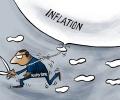
'Deposit and lending rates have started to fall considerably. It is likely to spur investment and consumption of durables.'

Brokerage Bernstein has warned Prime Minister Narendra Modi that India risks squandering recent economic gains unless it accelerates structural reforms, particularly in jobs, manufacturing and innovation.

India's electric motorcycle market is experiencing significant growth, with a 28 per cent year-on-year increase in volumes, as new product launches and improved total cost of ownership attract a broader base of riders beyond early adopters.

A US federal judge has ruled that the USD 100,000 fee imposed by former President Donald Trump for H-1B visa applications was unlawful, as it lacked congressional approval. The ruling states the fee was a tax, exceeding the administration's authority and impacting skilled global talent.

India's economic growth is expected to be lower at 6.3 per cent this fiscal compared to the RBI's projection of 6.5 per cent, a SBI Research Report said on Thursday. The report pegged the first quarter GDP estimate at around 6.8-7 per cent, mainly due to muted private capex.
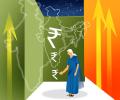
'I will not be surprised if there is a 7 per cent handle in front of the decimal place for the full financial year.'

India offers good long-term investment opportunities.

Both crude benchmarks are now down around 20 per cent since their last peak in June
